How Much Does AI Cost Your Company? Count It Before You Buy

Billcall tells a company what its AI will cost before anything is bought, and what was spent every week after. It is a free, open-source plugin for Claude Code, Anthropic's AI assistant that works with the files on your computer. You describe your people and your plans in plain words; Billcall answers with a monthly bill, the price of each finished task and the alternatives side by side. Every price comes from one table in which each row names the vendor's page and the day it was read. The counting happens on your own computer, from your answers and from files you already have: no account, no card, and no API key (the access code programs use to call an AI).
Why the bill is hard to predict
AI is sold in two ways at once. A seat is a monthly subscription for one person: a Claude Team seat costs $20 a month (Standard) or $100 (Premium), billed annually. Usage-based pricing charges for every token, the small pieces of text a model reads and writes; that is how the API, the pay-as-you-go access for your own programs, is billed. Claude Enterprise mixes the two: a $20 seat for access, with all usage billed on top at API rates. Seat prices alone don't say which plan is cheaper: Claude Team Standard and ChatGPT Business both cost $20 a person a month billed annually. What decides the bill is how much each person uses.
And use differs a lot. Anthropic's own cost guide puts Claude Code at about $13 per developer per active day across enterprise deployments, $150 to $250 a month. Uber, which pushed its staff to use AI coding tools, used up its whole 2026 budget for them in four months. Billcall lets a company of any size see its own numbers first.
A worked example
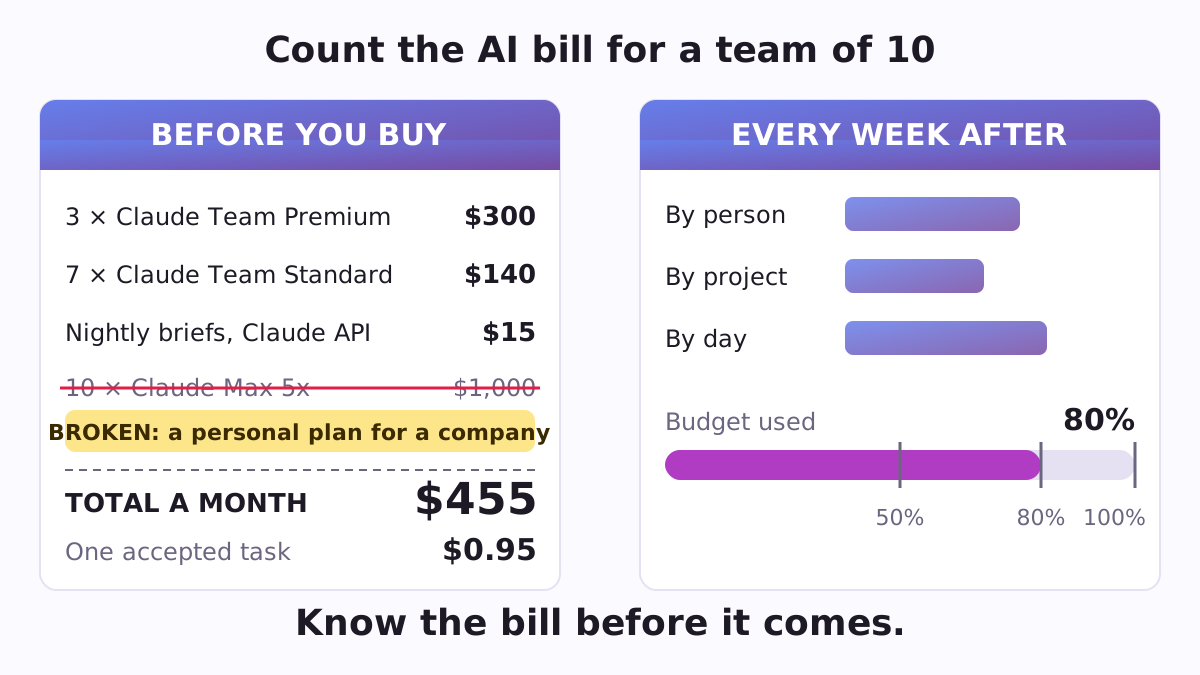
The repository comes with an agency of 10 people. Three of them work with an AI agent most of the day; seven write letters and documents and hand an agent a few tasks a week; and every night a scheduled job reads the day's mail and writes short briefs. Billcall prices this from its table:
- three Premium Team seats: $300
- seven Standard Team seats: $140
- the nightly job on Claude Haiku 4.5 through the API's half-price batch mode: $15
That is $455 a month, or $0.95 for each accepted task (600 tasks a month, 80% accepted).
Then it sets alternatives beside it. Everyone on a Standard seat: $215, with a note that people working with an agent all day use up a seat's allowance far faster than people who chat. The nightly job on DeepSeek V4.1 Flash: $8.40 instead of $15. Next to every model swap, Billcall prints a public quality score from the Artificial Analysis leaderboard, so a cheaper but weaker model never passes for a plain saving; here the cheaper one scores higher (39 against 17).
If a draft puts the whole company on a plan sold to one person, such as Claude Max, or runs scripts on a personal login, Billcall prints a BROKEN line naming the vendor's rule, so the plan gets fixed on paper, before anyone pays for it.
What it does
- The bill before you buy. Who uses AI and how much, what should run on its own, and what you already pay for (Microsoft 365 Copilot, Google Workspace with Gemini). Billcall separates new money from money already spent and flags rules the mix breaks: too few or too many seats, a personal plan for a company, a vendor your company has chosen not to use.
- A check before a script runs. Before a script starts working on a plan, Billcall says whether that plan may carry it.
- What was spent this week. From Claude Code's own logs on the computer, from the spend report a Team or Enterprise admin exports, or from an OpenTelemetry export (an open standard that monitoring tools read). Given the seat list and the activity report, it names the seats nobody used.
- What the agents did. Per person, project and day: sessions, tool calls, tokens and cost at list price. Collect each person's log folder and you get one table for the whole team.
- A budget alarm. Set a daily or monthly budget once; when a Claude Code session starts, Billcall says in one line how much is spent, at 50%, 80% and 100%, in English, Spanish, Portuguese, Russian or Ukrainian.
- Team or Enterprise. For 40 people using $60 a month each at API rates, Enterprise costs $3,200 against $4,000 for all-Premium Team; Enterprise stays cheaper while use is under $80 a person. If you negotiated your own rates, Billcall writes them in the form Claude Code reads, so the costs your people see match your contract.
- Your own machine or rent. A $16,000 RTX PRO 6000 graphics card, spread over 36 months with electricity, beats renting the same card on Runpod at $2.09 an hour once it works more than 30% of the month.
- Everyone side by side. One table for the big US vendors (Anthropic, OpenAI, Google, xAI, Meta, with Microsoft and GitHub), one for Chinese models (DeepSeek, Kimi, Qwen, GLM, MiniMax, MiMo, BytePlus, with where data is processed and the model's licence), and one for running models on your own hardware.
Where the numbers come from
All prices live in one file: 147 rows from 42 vendors, covering team seats, API tokens, coding plans, free tiers, hardware and rented GPUs, read from the vendors' pages on 2 and 3 October 2026. A built-in checker turns red when a row lacks its source page, a price is more than 92 days old, or a promotion is past its end date.
Popular trackers such as ccusage show one person's Claude Code use; Billcall adds the company view and the bill for a mix you haven't bought yet. It is a single Python file with no code for going online, so it runs even on a computer cut off from the internet.
How to start
In Claude Code, add the Poly A1 catalogue and install Billcall (no git and no GitHub account needed):
/plugin marketplace add https://raw.githubusercontent.com/vadimchernets/poly-a1-plugins/main/.claude-plugin/marketplace.json
/plugin install billcall@poly-a1
Then say what you want counted, in your own words: "what would Claude cost our 12 people", "what did we spend this week", "set a budget of 40 dollars a day". Billcall asks its questions one at a time, writes a small company profile with you and runs the numbers. It needs Python 3.8 or newer and works on Mac, Linux and Windows. The script also runs without Claude Code; the repository explains how.
Code, price table and both example companies: github.com/vadimchernets/billcall.
Where it fits
Billcall is one of the company plugins in the Poly A1 plugins catalogue. They share one company policy file: Firmcall writes it, and Billcall, Gatecall and Routecall read it, so a budget or a list of approved vendors is written once. Billcall is written by Vadym Chernets, released under the Apache-2.0 licence and archived on Zenodo (DOI 10.5281/zenodo.23116722).
Vadym Chernets also builds Poly A1, an app in which AIs from different companies check each other's work.