Claude Code for Pastors, Nurses, Teachers, Artists and Realtors: Free Kits
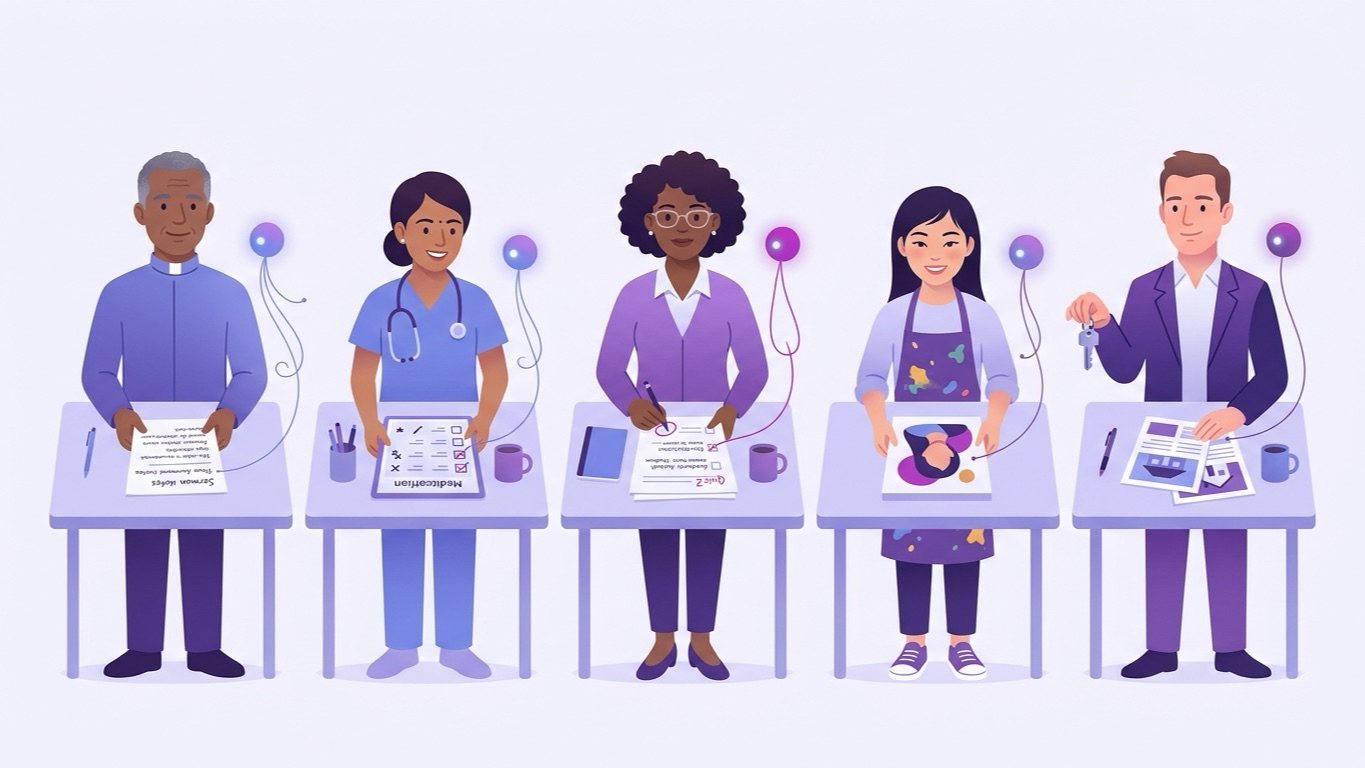
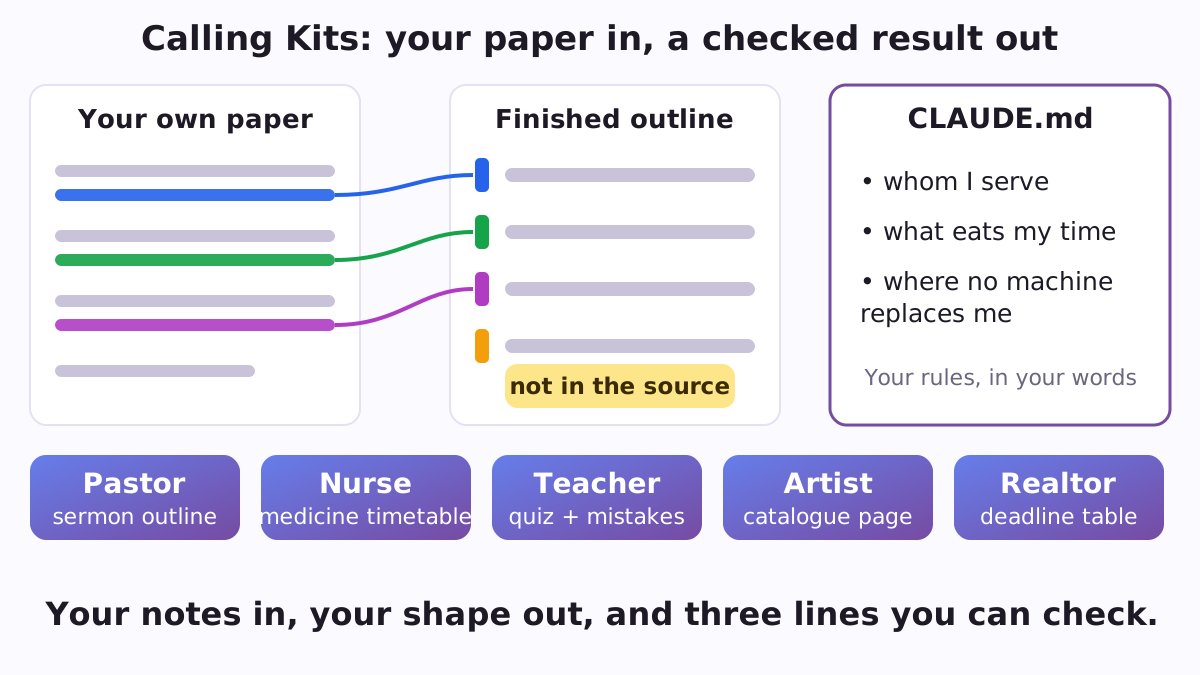
Calling Kits are five free add-ons for Claude Code, Anthropic's AI assistant that works with the files on your own computer. There is one kit for each of five trades: pastor and chaplain, nurse and family caregiver, school teacher, artist and craftsperson, and realtor. Each kit learns your rules, agrees the shape of every result with you first, and ends every job by showing three lines of the result next to the sentence in your own paper each one came from.
The kits are written for adults who are not programmers. They need no API key (the access code programs use to call an AI), no server and nothing beyond your Claude plan. Every command leaves its result in your folder as an ordinary file, a spreadsheet or a page of text, that opens in Excel, Numbers or Word.
Why these five trades
Most Claude Code plugins are made for programmers. On 10 October 2026 the official Claude Code plugin catalogue held 315 plugins, and not one mentioned a pastor, a nurse, a teacher, an artist or a realtor. People in these trades are looking all the same: type "ai for pastors" into Google and it suggests "claude ai for pastors"; type "claude for realtors" and it suggests "claude code for realtors".
US teachers who use AI every week say it saves them 5.9 hours a week, about six weeks of a school year (Gallup), and a third of US Protestant pastors are experimenting with it (Lifeway Research). A general chatbot does not know your congregation, your ward, your school's template or your market. The kits learn your rules, and they show their sources.
Six parts in every kit
- An interview about your calling. The first command,
profile, asks six questions one at a time: whom you serve, what eats your time, what you handle with your hands, where no machine replaces you, what you are wary of, and what a good day ends with. Your answers become a one-pageCLAUDE.mdin your folder, the rules file Claude Code reads before every job, in your own words. - A golden example. One piece of your own work you are proud of, kept in a
Referencefolder. The kit matches its order, headings and tone, so new work starts from your best day. - The shape, agreed first. Every command names the columns or parts of the result, shows two invented sample rows and waits for your yes. A wrong shape caught at row three costs three lines.
- Three lines checked against your paper. Every command ends by quoting three lines of the result beside the sentence each came from. Where your paper says nothing, the result says "not in the source" instead of guessing.
- A work log. One line per job in
work-log.md: the date, what was done, how long it would have taken by hand. After a month your own numbers show which command saves you the most. - Red lines, with their sources. Each kit's
red-lines.mdnames what it never does and where that line comes from, such as the Vatican's Antiqua et Nova for the pastor, the American Nurses Association for the nurse, or the Fair Housing Act for the realtor.
What each kit does
Pastor and chaplain (pastor-kit). sermon-outline turns your notes and a passage into an outline in your own shape, each movement with its verse and the note it came from; the sermon stays yours. week-notices turns a week of scattered messages into one page of notices and lists every scrap it could not place. visit-plan makes a printable round of visits. service-order builds the order of service for a funeral or wedding in your congregation's pattern. Scripture comes from the King James Version or the World English Bible, both free to print.
Nurse and family caregiver (nurse-kit). med-schedule lays out a prescription or discharge page as an hour-by-hour medication schedule, every medicine and dose copied word for word, each row quoting its line. handoff-notes sorts shift notes into a handoff report, marks every gap NOT IN NOTES, and leaves the assessment and recommendation, the A and R of SBAR, for the nurse to write. family-update turns notes into one plain page for relatives, with three questions to ask the doctor.
School teacher (teacher-kit). lesson-plan turns one topic into a plan with a hook, timings, the same task at two levels, a check for understanding and an exit ticket, in your school's template if you keep one in Reference. quiz-and-mistakes makes a quiz from your chapter plus a sheet of the wrong answers to expect and what to reteach. parent-note writes the letter home, with [NAME] wherever a child's name belongs.
Artist and craftsperson (artist-kit). catalogue-page turns a shelf of finished pieces into a price list and a page to print for a fair. artist-statement builds your statement from your own answers in 50, 150 and 300 words, with gallery words such as "explores" and "liminal" banned. commission-brief turns a client conversation into a written summary and a list of questions to settle before you start.
Realtor (realtor-kit). listing-copy writes remarks within your MLS character limit, a short version for a portal, and a line-by-line fair housing check that names each phrase to avoid and offers one that describes the property instead. comps-sheet lays your own comparable sales side by side for a CMA, every adjustment written as arithmetic you can follow (+80 sq ft x 40 = +3,200). deadline-table finds every date and deadline in one contract, with the clause it came from; a date it had to count is marked "calculated, check".
The first evening
Every kit has an examples folder with an invented document full of deliberate traps: a medicine taken every other day, sermon notes with an unchecked claim about a Greek word, a lease that defines its days in one clause only. Spend the first evening there: in the pastor kit, the outline built from the invented notes on Luke 15 marks the Greek claim as unchecked, because the notes said so. Then bring your own work.
Spreadsheets are written with semicolons and a sep=; first line, so they open correctly in Excel even where the comma is a decimal separator, as in Germany and Ukraine. Where a real Word file is wanted, the command names the one free library it needs and installs nothing until you say yes.
How to start
The kits run in Claude Code, which comes with a Claude Pro plan or higher. A verified US K-12 teacher can get it free for a year: Claude for Teachers includes Claude Code.
Make a folder for this work and open Claude Code in it. On a Mac: open Terminal, type
cdand a space, drag the folder onto the window, press Enter, then typeclaude. On Windows: open the folder in File Explorer, typecmdinto the address bar, press Enter, then typeclaude.Add the catalogue and install the kit for your trade:
/plugin marketplace add vadimchernets/calling-kits
/plugin install pastor-kit@calling-kits
The five names are
pastor-kit,nurse-kit,teacher-kit,artist-kitandrealtor-kit. If the new commands do not appear, type/exit, thenclaudeagain.Type
/pastor-kit:profile, or the same with your own kit's name, and answer the six questions. Every other command reads the result.
The teacher kit sits well beside Anthropic's own K-12 teaching skills, preinstalled in Claude for Teachers.
Also inside: 68 ideas for Christians
The repository also holds docs/for-christians, a reading catalogue of 68 cards on what a church member, a volunteer or a minister can do with an AI agent, plus a step-by-step plan for turning one card into a working project. It is text to read; nothing needs installing.
Where it comes from
Calling Kits are written by Vadym Chernets as teaching kits for a course for adults who are not programmers, and released under the MIT licence at github.com/vadimchernets/calling-kits. Every skill is a short, plain instruction file (SKILL.md) you can open, read and rewrite in your own words. The paper After Chat describes handing work to an AI as a contract with a goal, a boundary, an artefact and a check; the kits put that contract into each command. The same author's Sidecall and Roundcall ask several AIs one question and compare their answers.
Vadym Chernets also builds Poly A1, an app in which AIs from different companies check each other's work.