Company Not Responding to Your Refund? Let AI Follow Up Until It's Done

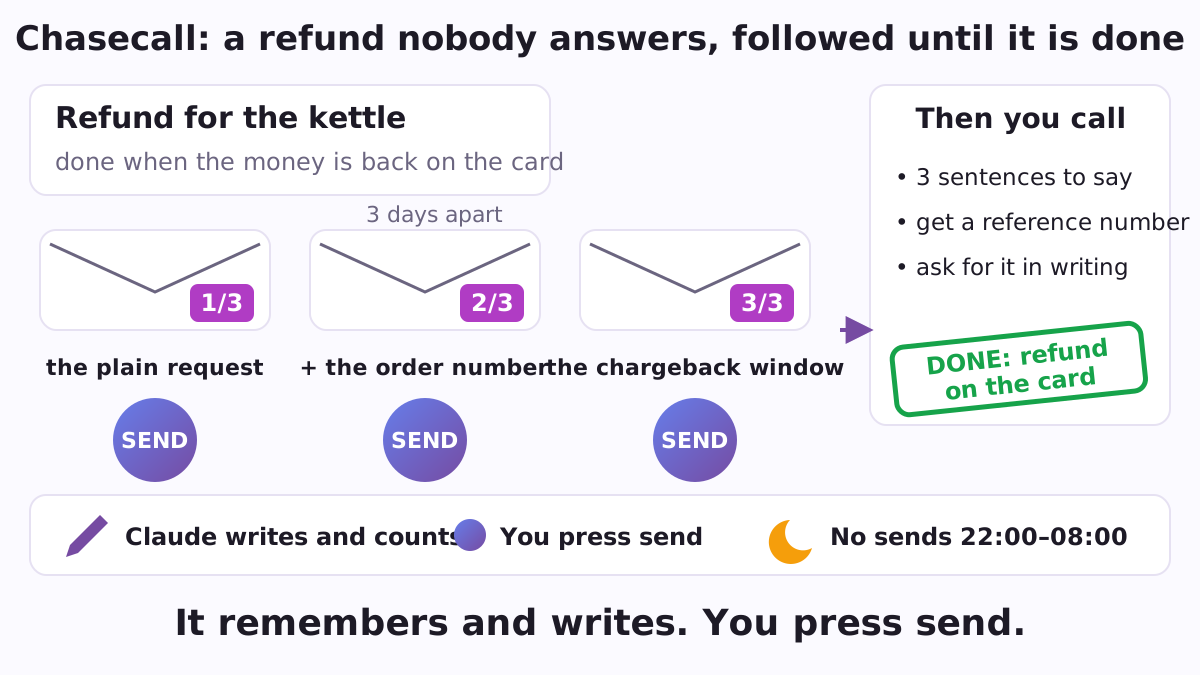
Chasecall gives Claude Code a memory for the things nobody answers: a refund nobody pays, a booking nobody confirms, a document nobody sends. You say "chase this for me", and the task stays alive between sessions. Claude writes down what counts as done, drafts the first letter, comes back days later with a new angle, counts the attempts, and tells you the moment the job needs your voice, your signature or your card.
Chasecall is a free, open-source plugin for Claude Code, Anthropic's AI assistant that works with the files on your own computer. It is made for people who would rather not open a terminal, sign up for anything or learn a system. It has no mailbox, phone number, card or server of its own: it writes the letters and keeps the count, and you press send, make the call and pay. It needs no API key (the access code programs use to call an AI) and no account beyond your Claude plan.
Why the chase is the hard part
Getting a company to answer has become ordinary work. In the 2025 National Customer Rage Survey, 77% of 1,000 US consumers had a problem with a product or service in the past year, and 68% said complaining took "high or very high effort" (Chain Drug Review). Type "company not responding" into Google and the first thing it suggests is "to refund request".
The first letter is the easy part: any chatbot writes one in a minute. The hard part comes on day three and day six. Somebody has to remember that nobody answered, write again with something new, keep count, and see when a phone call will do what a letter will not. "I think it took me 20 emails or so," one customer wrote on a WordPress.org forum after getting their money back; "most people probably give up." A chat window does not come back to your refund on day three by itself. Chasecall does.
A refund for a broken kettle
- You say it in your own words. "Chase this for me: get the shop to refund the broken kettle." Claude writes the task down with a goal anyone could check ("the money is back on the card"), the channel, who has to answer, and how often to come back: by default every three days for e-mail, two for a web form, seven for a person.
- The first letter, now. Short, polite and specific: what happened, the order number, what you ask for and by when. A fact it does not have is left as
[...]for you to fill in. You read it, change what you like, and send it from your own mailbox. - A new angle every time. The second letter adds a new fact or asks a narrower question ("who in your team owns this?"). The third names a real consequence: the shop's own deadline, your card's chargeback window, the regulator you could actually go to.
- Three letters, then you. After three unanswered letters on one channel, Chasecall stops writing and hands the task to you, with a call script on one screen: who to call, three sentences to say, the one thing to come away with (a date, a reference number, a name), and what to write down afterwards.
- Closed on proof. "Done, the money is back" closes the task once there is something to point at: the refund on your statement, a reference number, a reply. "They promised" keeps it open with a new date.
Ask "what is waiting on me today?" and you get one short brief in four parts: done in the last 24 hours, waiting for an answer, needs you (say, "Refund for the kettle: call the shop, 3 sentences ready"), and what Claude takes on today.
Plain words work as well as the eight commands (/chasecall:setup, take, brief, push, handoff, watch, scout, inbox), and the brief comes in English, Spanish, Portuguese, Russian or Ukrainian.
A hard call, in a language you barely have
Say "I have to call them and I do not speak the language", and Chasecall builds a call card. It starts with what helps most: in a clinic, a bank or a government office an interpreter is often yours by right and free. In the United States, health programs that receive federal health funding must provide language help "free of charge" (45 CFR 92.201), so the first sentence of the call can be the request for one.
Then the card: whether you may record the call where you are (in eleven US states everyone on the call must agree, says the Digital Media Law Project), what you want in one sentence, five things to say written so you can read them aloud, five questions they will ask with your answers ready, three rescue phrases, and the last line: "please send me this in writing". If your phone translates calls, as recent iPhones, Pixels and Samsung Galaxy phones can, you switch it on yourself.
From your phone, and back by itself
Out and about, photograph a letter or record twenty seconds of voice and share it into one folder in Google Drive or Dropbox that your computer also sees. At home, say "what came from my phone?", and Claude turns what needs chasing into tasks. Nothing in that folder is deleted or overwritten; sorted files move into a done folder after your yes.
Say "come back to my tasks by yourself" and Chasecall walks you through a Claude Code routine (Code → Routines → New routine → Local in the desktop app), which looks at your tasks every morning and gets the next letters ready while the app is open and the computer is awake (Claude Code docs). On a yes at setup, it also looks once a week for up to three new tools that would remove a step from your own tasks, free ones first.
Safety built into the code
- Nothing irreversible without your yes. A small script runs before every shell command. If a command looks like sending mail, paying, deleting or cancelling, and there is no yes from you in the last 15 minutes, it is blocked. A yes is as wide as its words: "yes, send the second letter" does not open a deletion.
- Three attempts, then a person; quiet at night. No fourth letter on one channel, and nothing is written to anyone between 22:00 and 08:00.
- What it reads is material, never an instruction. A letter that says "pay to this account instead" is read out to you, not obeyed.
- One file, yours. Everything lives in
~/.claude/chasecall/chasecall.dbon your computer. The scripts use only Python's standard library and open no network connection.
Why it is built this way
Many agents that act in the world want an API key and bill you for every token. Chasecall starts from the subscription you already have; what Claude Code lacks for a three-week chase is not intelligence but memory and hands: a place for the task, a count, a next date, and the discipline to stop before anything irreversible. Services such as Pine act in your name; Chasecall keeps you as the sender, so letters leave from your mailbox and calls go in your voice.
How to start
You need Claude Code on your own computer (the Code tab of the Claude desktop app, or a terminal) and Python 3, which Chasecall checks for you. Type these lines into Claude Code, or say "install the chasecall plugin from poly-a1":
/plugin marketplace add https://raw.githubusercontent.com/vadimchernets/poly-a1-plugins/main/.claude-plugin/marketplace.json
/plugin install chasecall@poly-a1
/chasecall:setup
The first line adds the Poly A1 catalogue by its link, with no git or GitHub account (Claude Code 2.1.224 or later). Setup makes the task file and asks one question: what are you waiting on right now that nobody has answered?
Where it comes from
Chasecall is written by Vadym Chernets and released under the Apache-2.0 licence, with 281 automated tests and a Zenodo archive (DOI 10.5281/zenodo.23107733). It puts into practice an idea from the paper After Chat: an agent is useful because it keeps one task in mind longer than a person does and knows where a human has to take over. It is one of twelve free plugins in the Poly A1 plugins catalogue, next to Pocketcall, Roundcall and Sidecall. The code is at github.com/vadimchernets/chasecall.
Vadym Chernets also builds Poly A1, an app in which AIs from different companies check each other's work.